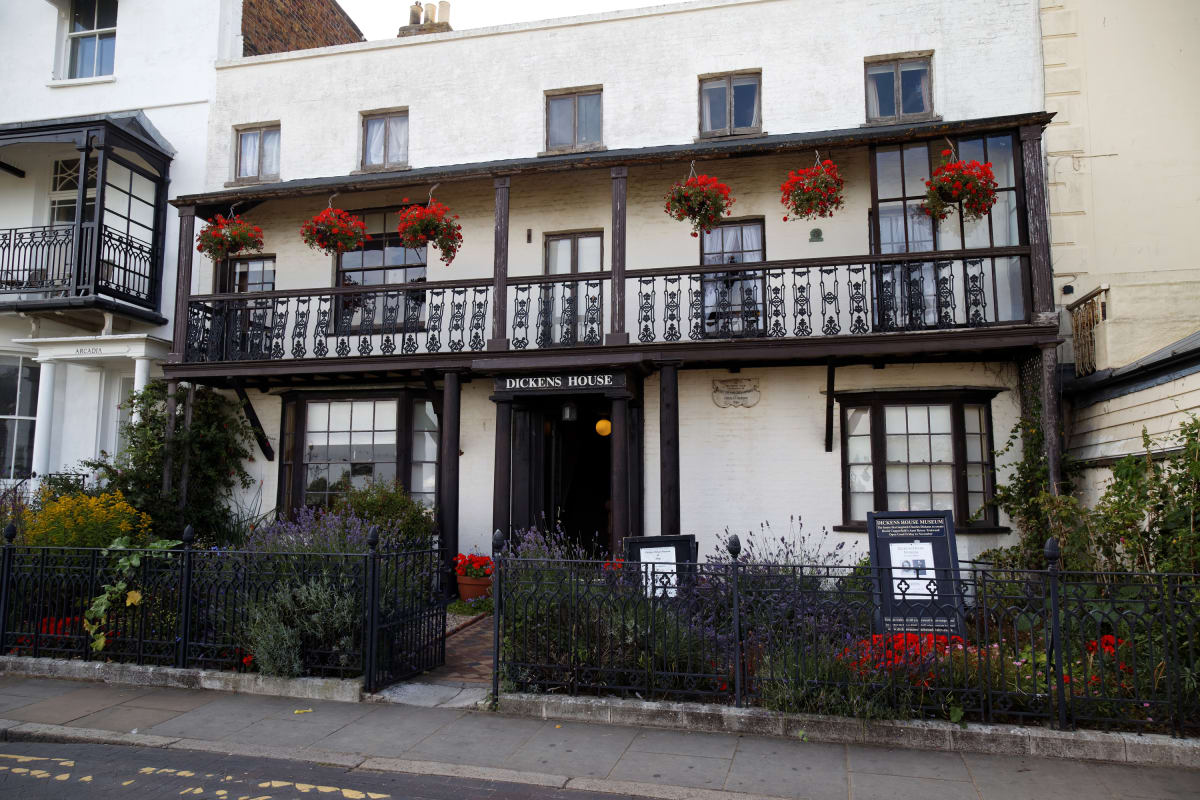
The Victorians were quick to realise that writers’ houses are effective ‘tools to stimulate one’s imagination. They have this function for the authors who design and inhabit them, and it works the same way with the people who later visit them’.1 Gad’s Hill in Cobham, where Dickens spent the last years of his life, continues to attract attention (as does the famous writing chalet now situated in nearby Rochester). The idea of reading about an author’s ‘Homes and Haunts’ alongside favourite books was popular with readers from the 1840s, and ultimately gave rise to what was termed ‘literary pilgrimage’. By the 1880s, the trend for visiting other sites associated with famous writers was well underway, creating ‘an increasingly dense cultural map.’2
Book-length guides to Dickens’s Kent started to appear from around this time. Some, such as Robert Langton’s Charles Dickens and Rochester (London: Chapman and Hall, 1880) focused on a specific place. Others, such as Robert Allbutt’s 1886 Rambles in Dickens-Land, offered a wider scope and practical suggestions for undertaking literary walks and trips. Both Thomas Frost’s 1880 In Kent with Charles Dickens and William R. Hughes’s 1891 A Week’s Tramp in Dickens Land tell the story of the writers’ own adventures in Kentish Dickens Land.
The presence of Dickens himself was not the only lure. The desire for a particular place to be proved the ‘real’ location for a novel could lead to intense competition, suggested by the challenging title of The Real Dickens Land written by Henry Snowden Ward and Catherine Weed Barnes Ward in 1904.
Broadstairs is a case in point. Dickens stayed in Fort House on a number of occasions, and wrote part of the 1848-50 novel David Copperfield from a room with an excellent sea view. (Incidentally, the enterprising James Simson of the Weekly News, 62 Hight St, later spent a night in this room and declared that ‘the howling and whistling of the wind down the wide chimneys and through the exposed nooks and crannies of the old house was just a little too much for his nerves’).3 Rumours that part of Bleak House were written here are entirely unfounded, but this did not prevent the house from being informally known as Bleak House from around 1864 and officially renamed somewhere between 1883 and 1885.4
The town has a much stronger claim as the ‘real’ setting for David Copperfield. In the novel the young David famously walks from London to Dover, to the home of his aunt Betsey Trotwood. In 1887 J. Ashby Sterry wrote a serio-comic account of his search for the original site on Dover cliffs, guided by inspiration and an attractive servant he sees walking in the right direction:
In the distance I see what I fancy must be the house. The nearer I approach it the better satisfied I am; and directly I am in front of it, I have no doubt whatever on the subject. It is perhaps not quite so neat as it was in Miss Betsey Trotwood’s time; but there is no doubt that it is the house.5
But Dickens’s son Charlie later confirmed that the original source for Miss Betsey was actually Mary Pearson Strong, a spinster living at 2 Nuckell’s Place in Broadstairs. This was the house that would later become the Dickens House Museum.
Bibliography
Ashby-Sterry, J. ‘Miss Betsey Trotwood’s’. Cucumber Chronicles. Delhi: Facsimile Publisher, 2018. First published by Sampson Low, Marston, Searle & Rivington, London 1887. 156-66.
Booth, Alison. Homes & Haunts: Touring Writers’ Shrines and Countries. Oxford: Oxford University Press, 2016.
Directory for Broadstairs and St Peter’s, 1885.
Frost, Thomas. In Kent with Charles Dickens. London: Tinsley Bothers, 1880.
Hendrix, Herald. ‘Epilogue: The Appeal of Writers’ Houses.’ Writers’ Houses and the Making of Memory. Ed. Herald Hendrix. London: Routledge 2008. 235-243.
Hughes, William R. A Week’s Tramp in Dickens–Land. London: Chapman and Hall, 1891.
Kitton, Frederic G. Scrapbook 2 (p80). Dickens Museum, London.
Langton, Robert. Charles Dickens and Rochester. London: Chapman and Hall, 1880.
Oulton: Down From London: Seaside Reading in the Railway Age. Liverpool: Liverpool University Press, 2012.
Simson, James. Breezy Broadstairs. Repr. Ramsgate: Michael’s Bookshop, 2006 [1897].
Ward, Snowden H. and Catherine Weed Barnes Ward, The Real Dickens Land. London: Chapman and Hall, 1904.